There is a sobering truth every minister of the Gospel must understand:
The calling of God can open the door to ministry, but it does not automatically produce spiritual maturity.
A man may be called, anointed, gifted, and actively used by God, yet still neglect the personal spiritual development necessary to sustain the calling.
Many ministers have successfully guided others into destiny, yet later drifted spiritually themselves because they assumed the calling would carry them.
The Holy Spirit presses this warning strongly in Scripture.
1. The Calling of God Does Not Replace Personal Spiritual Discipline
The apostle Paul gave a command that applies strongly to ministers:
2 Timothy 2:15 (KJV)
“Study to shew thyself approved unto God, a workman that needeth not to be ashamed, rightly dividing the word of truth.”
The word “study” in Greek is spoudazo.
According to Thayer’s Greek Lexicon, spoudazo means:
to make haste to exert oneself to give diligence to be earnest and intentional
This means spiritual growth never happens accidentally.
It requires intentional effort, discipline, and pursuit of God.
A pastor must never assume that:
Preaching replaces Bible studying, Ministering replaces Praying, and Serving others replaces Personal communion with God.
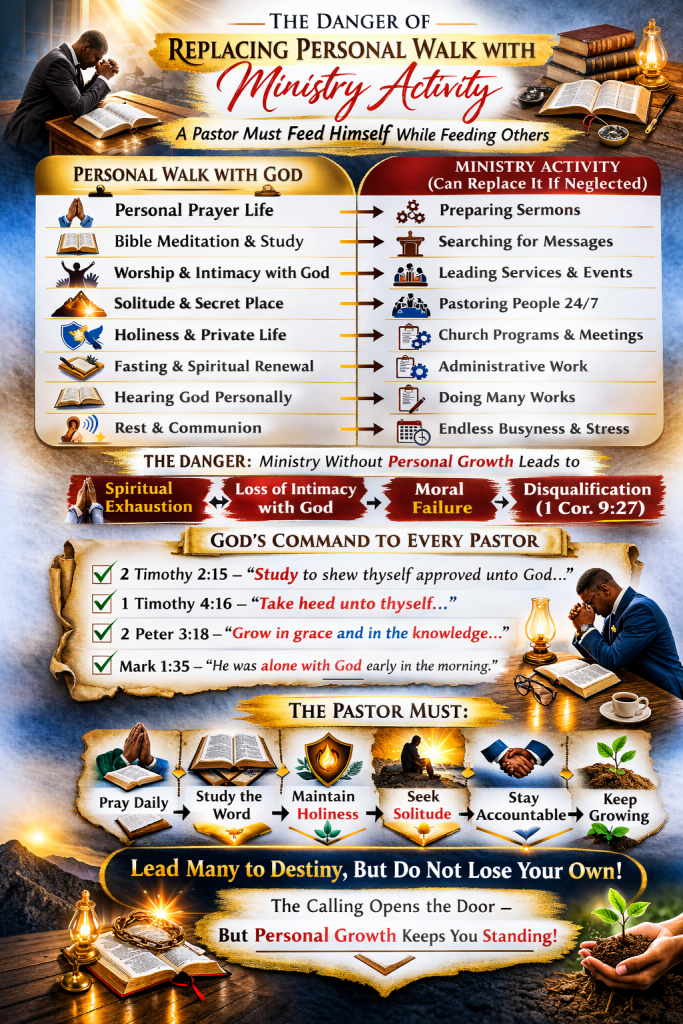
Ministry activity cannot substitute for personal spiritual growth.
2. Ministry Success Does Not Guarantee Personal Spiritual Health
One of the most sobering warnings in Scripture comes from Paul himself.
1 Corinthians 9:27 (KJV)
“But I keep under my body, and bring it into subjection: lest that by any means, when I have preached to others, I myself should be a castaway.”
The word “castaway” here is the Greek word adokimos.
According to Vine’s Expository Dictionary, adokimos means: disqualified, rejected after testing, failing to stand the test
Paul was saying something extraordinary:
Even after preaching to many, he understood the possibility that his own spiritual life could fail if he was not disciplined.
Notice the structure of the verse:
preached to others yet personally disqualified
Ministry influence does not protect a minister from spiritual decline.
3. The Anointing Does Not Automatically Produce Character
The Bible repeatedly shows that a calling can exist without corresponding spiritual maturity.
For example:
King Saul
Saul was: chosen by God anointed by the prophet Samuel empowered by the Spirit
1 Samuel 10:6 (KJV)
“And the Spirit of the Lord will come upon thee, and thou shalt prophesy with them, and shalt be turned into another man.”
Yet Saul later lost his spiritual position because he stopped obeying God and stopped growing spiritually.
Eventually God said:
1 Samuel 15:23 (KJV)
“Because thou hast rejected the word of the Lord, he hath also rejected thee from being king.”
The calling did not fail. Saul failed to grow into the calling.
4. Pastors Must Pastor Themselves First
One of the most important pastoral principles appears in Paul’s instruction to Timothy.
1 Timothy 4:16 (KJV)
“Take heed unto thyself, and unto the doctrine; continue in them: for in doing this thou shalt both save thyself, and them that hear thee.”
Notice the order:
Take heed unto thyself
Take heed unto doctrine
Then you save those who hear you
Many ministers reverse the order.
They focus on: pastoring people, running ministries, managing programs.
But neglect pastoring their own souls.
A pastor must first watch over his own spiritual life.
The Greek word for “take heed” is epecho, meaning: to hold firmly, to to give careful attention, to continually watch.
A pastor must continually monitor his own spiritual condition.
5. Ministry Can Slowly Replace Fellowship With God
One of the greatest dangers in ministry is substitution.
A pastor can unknowingly replace:
Personal walk with Ministry Activity
Prayer with Preparing Sermons
Bible meditation with Searching for messages
Worship with Leading services
Fellowship with God with Caring for people
Yet Scripture reminds us that Jesus Himself guarded His personal spiritual life carefully.
Mark 1:35 (KJV)
“And in the morning, rising up a great while before day, he went out, and departed into a solitary place, and there prayed.”
Even with the greatest ministry ever seen on earth, Jesus still guarded personal communion with the Father.
If Jesus needed solitude with God, every pastor certainly does.
6. The Pastor Must Continue Growing Spiritually
Peter commands all believers, but the instruction applies even more to ministers.
2 Peter 3:18 (KJV)
“But grow in grace, and in the knowledge of our Lord and Saviour Jesus Christ.”
The word “grow” comes from the Greek auxano, meaning: to increase, to enlarge, to advance
Spiritual life is not static.
If growth stops, decline begins.
A pastor must continually grow in: revelation, holiness, humility, spiritual authority, character, and intimacy with God.
7. The Danger of Becoming a Castaway
Jesus also warned about those who ministered in His name yet lost their spiritual standing.
Matthew 7:22–23 (KJV)
“Many will say to me in that day, Lord, Lord, have we not prophesied in thy name? and in thy name have cast out devils? and in thy name done many wonderful works?
And then will I profess unto them, I never knew you: depart from me, ye that work iniquity.”
Notice something frightening:
They had: prophesied, cast out demons, done miracles…
Yet Jesus said “I never knew you.”
This shows that ministry activity can continue even when personal fellowship has been neglected.
8. The Pastor Must Intentionally Build His Own Spiritual Life
Therefore, every pastor must intentionally cultivate:
Personal Prayer Life
Not only corporate prayers or ministry prayers.
Personal Word Study
Not only sermon preparation.
Personal Holiness
Guarding the heart and private life.
Personal Accountability
Remaining teachable and correctable.
Personal Growth
Continuing to learn and develop spiritually.
The pastor who feeds others must also feed himself.
Final Reflection
The calling of God is powerful.
It opens doors.
It releases grace.
It gives authority.
But the calling alone cannot replace personal spiritual discipline.
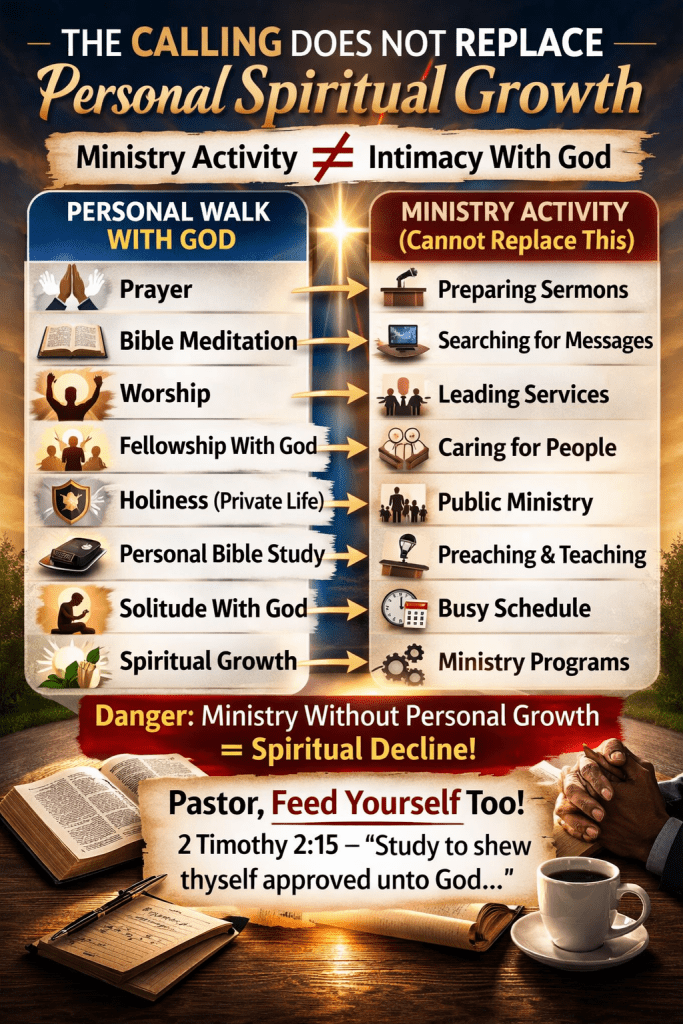
A pastor must never forget:
You can lead many people into destiny, yet lose spiritual ground personally if growth is neglected.
Therefore the instruction of Scripture remains vital:
2 Timothy 2:15
“Study to shew thyself approved unto God…”
The pastor must continually pursue God, so that after leading many to victory, he himself will not be disqualified.
If this teaching has challenged or strengthened you, share it with other ministers and believers.
👉 Read more teachings that build your spiritual life at corneliusbella.blog
The Message Bearer (SmilingPreacher), Cornelius Bella

 corneliusbella