Introduction: When a Prophet Stumbles
Few Bible moments are as sobering as the account of John the Baptist—the very forerunner of Jesus Christ—sending a message of doubt to the One he had already revealed to the world.
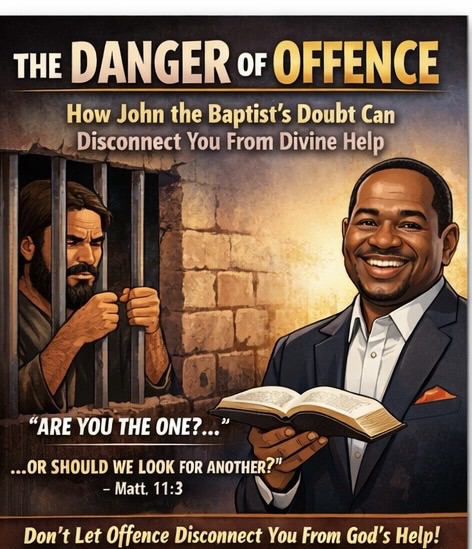
How does a man who declared, “Behold the Lamb of God” (John 1:29) now ask, “Are You the One who is to come?” (Matthew 11:3)
This is not just a historical moment. It is a spiritual warning.
1. The Root of Offence: Misaligned Expectations
Matthew 11:2–3 (KJV)
“Now when John had heard in the prison the works of Christ, he sent two of his disciples,
And said unto him, Art thou he that should come, or do we look for another?”
John was in prison. His expectations of how the Messiah would operate did not match his reality.
From a Bible Dictionary perspective, offence (Greek: skandalon) refers to:
A stumbling block
Something that causes a fall
A trap that leads to spiritual ruin
John was not offended in rebellion—but he was vulnerable to offence through disappointment.
Insight:
Offence often begins when:
God’s ways contradict our expectations
A man of God does not act according to our assumptions
We interpret divine silence as neglect
2. The Subtle Progression: From Doubt to Disconnection
John did not go directly to Jesus—he sent disciples.
This signals distance.
Proverbs 18:1 (KJV)
“Through desire a man, having separated himself, seeketh and intermeddleth with all wisdom.”
Offence isolates before it destroys.
Amplified Bible (AMP):
“He who [willfully] separates and estranges himself [from God and man] seeks his own desire…”
Key Progression
Disappointment
Internal questioning
Emotional withdrawal
Physical or relational separation
Vulnerability to deception
3. The Warning from Jesus Himself
Jesus responded to John—not with emotional reassurance—but with evidence of divine works.
Matthew 11:4–6 (KJV)
“Jesus answered and said unto them, Go and shew John again those things which ye do hear and see:
The blind receive their sight, and the lame walk…
And blessed is he, whosoever shall not be offended in me.”
The Message (MSG):
The devil does not devour everyone—he seeks the disconnected.
“Is this what you were expecting? Then count yourselves most blessed!”
Jesus revealed a powerful truth:
Offence can make you miss what God is clearly doing.
4. The Danger: Disconnection from Divine Assistance
John had once operated under open heavens:
John 1:32–34 (KJV)
“I saw the Spirit descending from heaven like a dove, and it abode upon him…
And I saw, and bare record that this is the Son of God.”
Yet later, he struggled.
Why?
Because proximity to divine truth does not guarantee continued participation in it.
From a concordance study, “abide” means:
To remain
To continue
To stay connected
John had revelation—but his situation challenged his continuity in that revelation.
5. The Consequence: Becoming Vulnerable to the Adversary
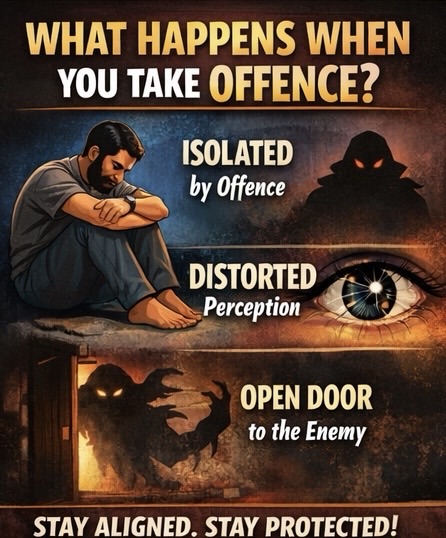
Offence creates a spiritual gap—and the adversary exploits gaps.
1 Peter 5:8 (KJV)
“Be sober, be vigilant; because your adversary the devil, as a roaring lion, walketh about, seeking whom he may devour.”
Notice:
Ephesians 4:26–27 (KJV)
“Let not the sun go down upon your wrath:
Neither give place to the devil.”
Key Insight:
Offence is not just emotional—it is territorial. It gives the enemy legal ground.
6. A Sobering Reality: John’s End
John the Baptist was eventually executed (Matthew 14:10).
While Scripture does not explicitly say offence caused his death, the spiritual principle remains clear:
When a believer becomes disconnected from divine alignment, they become vulnerable in ways they were never designed to be.
Even Jesus said:
Matthew 11:11 (KJV)
“Among them that are born of women there hath not risen a greater than John the Baptist…”
Yet greatness did not exempt him from the danger of misalignment.
7. The Lesson: Honour, Alignment, and Spiritual Safety
Hebrews 13:17 (KJV)
“Obey them that have the rule over you, and submit yourselves: for they watch for your souls…”
To disconnect from a genuinely called man of God is not merely relational—it is spiritual exposure.
Psalm 133:1–3 (KJV)
“Behold, how good and how pleasant it is for brethren to dwell together in unity!
…for there the Lord commanded the blessing, even life for evermore.”
Unity preserves life. Offence exposes life.
8. Guarding Your Heart Against Offence
Practical Safeguards
Stay rooted in the Word Not feelings or assumptions
Clarify, don’t conclude
Seek understanding before forming judgment
Discern divine patterns
God does not always act how we expect
Remain connected
Spiritual covering is not optional—it is protection
Deal with offence quickly – Delay strengthens the adversary’s hold
Conclusion: The Cost Is Too High
John the Baptist’s moment of doubt is not recorded to condemn him—but to warn us.
Offence against divine alignment can:
Distort perception
Break connection
Withdraw assistance
Expose to the enemy

Luke 7:23 (KJV)
“And blessed is he, whosoever shall not be offended in me.”
This is not just a statement—it is a survival principle.
Final Charge
Stay aligned.
Stay connected.
Stay humble.
Because in the Kingdom:
Where offence enters, grace withdraws.
Where alignment remains, divine assistance flows.
The Message Bearer, Cornelius Bella

 corneliusbella