There are scriptures that inform you, and there are scriptures that confront you.
Ephesians 5:1–7 does both—it defines the Christian life with precision and authority.
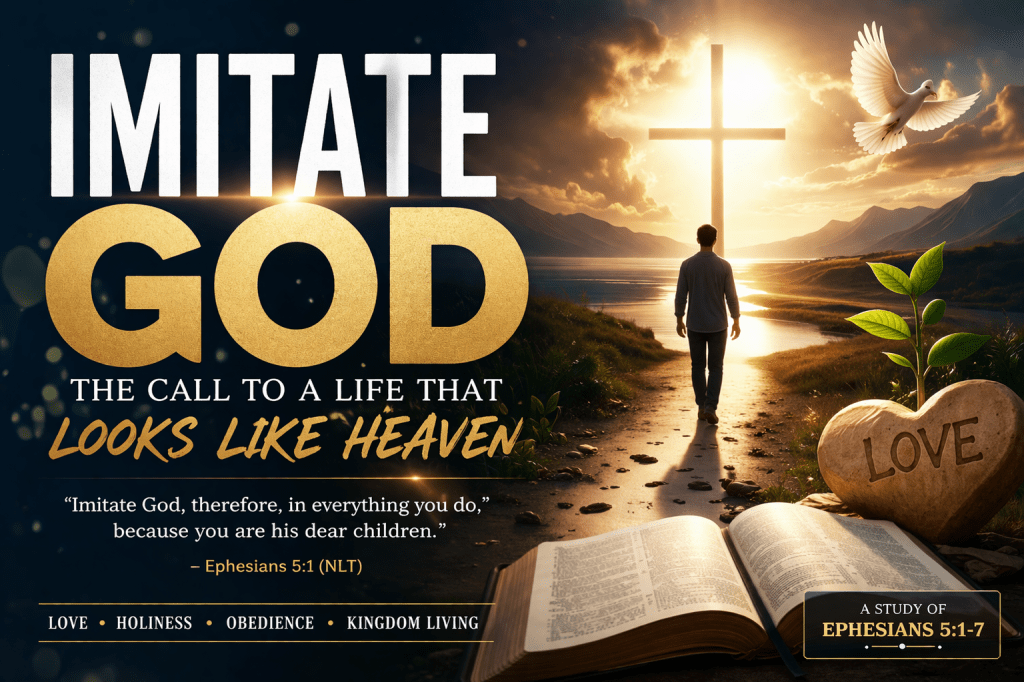
This is not a suggestion. It is a pattern for living.
1. The Foundation: Identity Before Instruction
Let us begin with the Scripture itself:
Ephesians 5:1–2 (NLT)
“Imitate God, therefore, in everything you do, because you are his dear children. Live a life filled with love, following the example of Christ. He loved us and offered himself as a sacrifice for us, a pleasing aroma to God.”
The instruction begins with identity:
“because you are his dear children.”
The Greek word used here for imitate is mimētēs—from which we get the word mimic. It means:
To copy
To model after
To reproduce the behaviour of another
This is not superficial imitation. It is character replication.
A Bible concordance reveals that this word is used for disciples who so closely follow their master that their lives become a visible expression of him.
You are not called to admire God.
You are called to look like Him in conduct.
2. The Central Expression: A Life Governed by Love
“Live a life filled with love…”
The word love here is agápē—the God-kind of love:
Sacrificial
Unconditional
Self-giving, not self-seeking
The verse gives us the definition of this love:
“…following the example of Christ. He loved us and offered himself as a sacrifice for us…”
This connects love to sacrifice.
A Bible dictionary defines sacrifice (in this context) as:
A voluntary offering given to God Something costly, not convenient
Christ’s love was not emotional—it was transactional and redemptive.
Romans 5:8 (KJV)
“But God commendeth his love toward us, in that, while we were yet sinners, Christ died for us.”
To imitate God means:
You forgive when it costs you
You give when it stretches you
You serve when it is inconvenient
That is God-like living.
3. The Fragrance of a God-Like Life
“…a pleasing aroma to God.”
This language comes from Old Testament sacrificial systems.
Leviticus 1:9 (KJV)
“…and the priest shall burn all on the altar, to be a burnt sacrifice, an offering made by fire, of a sweet savour unto the LORD.”
A life lived in love becomes:
A spiritual offering
A fragrance God recognizes
A life Heaven responds to
God does not just hear your prayers—
He smells your life.
4. The Clear Boundaries: What Must Not Be Found Among You
Now the tone shifts from imitation to separation.
Ephesians 5:3–4 (NLT)
“Let there be no sexual immorality, impurity, or greed among you. Such sins have no place among God’s people. Obscene stories, foolish talk, and coarse jokes—these are not for you. Instead, let there be thankfulness to God.”
A. Sexual Immorality (Porneia)
A concordance defines porneia as:
All sexual activity outside God’s design for marriage
This includes:
Fornication Adultery Sexual perversion
God is not adjusting His standards to culture.
1 Thessalonians 4:3 (KJV)
“For this is the will of God, even your sanctification, that ye should abstain from fornication:”
B. Impurity
This refers to:
Moral uncleanness
Internal corruption of thoughts and desires
Jesus addressed this at the root level:
Matthew 5:28 (KJV)
“But I say unto you, That whosoever looketh on a woman to lust after her hath committed adultery with her already in his heart.”
C. Greed (Covetousness)
The Scripture gives a shocking definition:
“…a greedy person is an idolater…”
Why?
Because greed transfers worship from God to things.
Colossians 3:5 (KJV)
“…covetousness, which is idolatry:”
A Bible dictionary explains idolatry as:
Giving ultimate value or trust to anything other than God
Greed is not just desire—it is misplaced worship.
D. Speech That Corrupts
“Obscene stories, foolish talk, and coarse jokes…”
Your speech reveals your spiritual condition.
Luke 6:45 (KJV)
“…for of the abundance of the heart his mouth speaketh.”
Instead of corrupt speech:
“…let there be thankfulness to God.”
Gratitude is the language of a God-like life.
5. The Warning: Eternal Consequences Are Real
Ephesians 5:5 (NLT)
“You can be sure that no immoral, impure, or greedy person will inherit the Kingdom of Christ and of God…”
This is not symbolic language.
This is doctrinal reality.
The Kingdom of God is not entered by confession alone—it is evidenced by transformation.
1 Corinthians 6:9–10 (KJV)
“Know ye not that the unrighteous shall not inherit the kingdom of God? Be not deceived: neither fornicators, nor idolaters, nor adulterers, nor effeminate, nor abusers of themselves with mankind,
Nor thieves, nor covetous, nor drunkards, nor revilers, nor extortioners, shall inherit the kingdom of God.”
6. The Final Instruction: Refuse Deception, Reject Participation
Ephesians 5:6–7 (NLT)
“Don’t be fooled by those who try to excuse these sins… Don’t participate in the things these people do.”
We live in a generation that:
Redefines sin
Normalizes compromise
Justifies disobedience
But Scripture says:
Do not be deceived.
Truth is not determined by culture—it is established by God.
7. Living “According to the Scriptures”
This passage aligns perfectly with the divine mandate:
Everything in your life must be according to the Scriptures.
To imitate God means:
Your relationships must reflect Scripture
Your speech must reflect Scripture
Your desires must be governed by Scripture
Your lifestyle must align with Scripture
Conclusion: The Measure of a True Christian Life
The Christian life is not defined by:
Church attendance
Religious language
Emotional experiences
It is defined by likeness to God.
1 John 2:6 (KJV)
“He that saith he abideth in him ought himself also so to walk, even as he walked.”
Final Charge
Imitate God.
Not partially.
Not occasionally.
In everything you do.
Reject what He rejects.
Love how He loves.
Live as Christ lived.
And your life will become:
A message on earth
A fragrance in heaven
A testimony that cannot be denied
The Message Bearer, Cornelius Bella

 corneliusbella