Introduction: When “Later” Sounds Spiritual but Isn’t
One of the most subtle traps believers fall into is delayed obedience—the habit of agreeing with God in principle while postponing action in practice. We hear God, we nod internally, we even say amen—but we wait.
Scripture is clear: God values obedience in real time. What we call delay, heaven often records as disobedience.
This teaching explores the biblical foundation of obedience, exposes the spiritual cost of delay, and calls believers back to prompt, wholehearted response to God.
The Nature of Biblical Obedience
In Scripture, obedience is not merely agreement; it is action aligned with instruction.
“If ye be willing and obedient, ye shall eat the good of the land.” (Isaiah 1:19, KJV)
Notice the order: willing (inner consent) and obedient (outward action). Willingness without obedience does not unlock God’s promises. Timing matters to God, because His instructions are often connected to specific seasons, people, and outcomes.
Delayed obedience may appear harmless, but it subtly disconnects action from instruction, weakening spiritual authority and momentum.
Case Study 1: Saul — Partial and Delayed Obedience
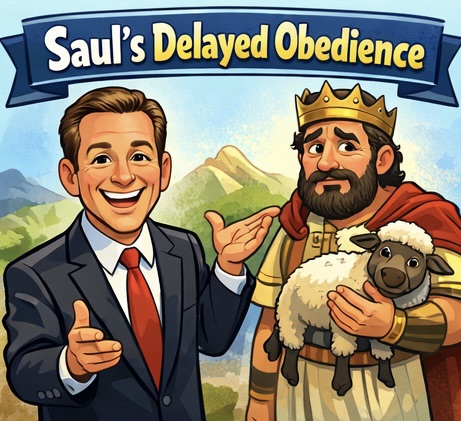
In 1 Samuel 15, King Saul received a clear command from God through the prophet Samuel. Saul acted—but not fully and not precisely. He spared what God said to destroy and justified his delay with religious language.
Samuel’s response exposes heaven’s verdict:
“To obey is better than sacrifice, and to hearken than the fat of rams.” (1 Samuel 15:22, KJV)
Saul’s problem was not rebellion in attitude but delay and modification in obedience. He obeyed late, selectively, and with explanations. God rejected him as king—not because he ignored God, but because he did not obey promptly and completely.
Lesson: Obedience that is delayed, edited, or negotiated is disobedience.
Case Study 2: Jonah — Obedience After Damage

Jonah heard God clearly and chose delay by running in the opposite direction. Eventually, Jonah obeyed—but only after loss, crisis, and unnecessary suffering.
While God mercifully restored Jonah, the delay cost him:
Peace
Witness
Comfort
Time
Jonah’s story teaches that eventual obedience does not erase the consequences of initial delay. God’s purpose may still stand, but the journey becomes harder than necessary.
Why Believers Delay Obedience
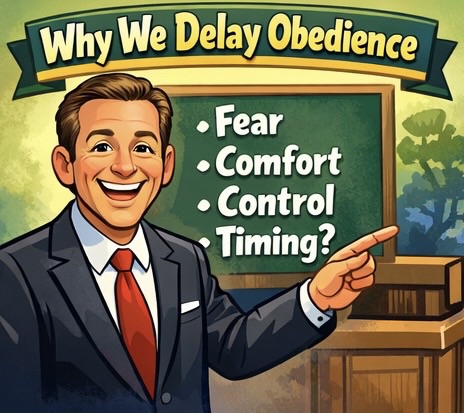
Delayed obedience is rarely rooted in ignorance. More often, it flows from:
Fear of consequences
Attachment to comfort
Desire for control
Waiting for “better timing”
Over-spiritualising decisions God already settled
Yet Scripture warns:
“Today if ye will hear his voice, harden not your hearts.” (Hebrews 3:15, KJV)
Delay hardens the heart. The longer obedience is postponed, the weaker conviction becomes.
The Cost of Delayed Obedience
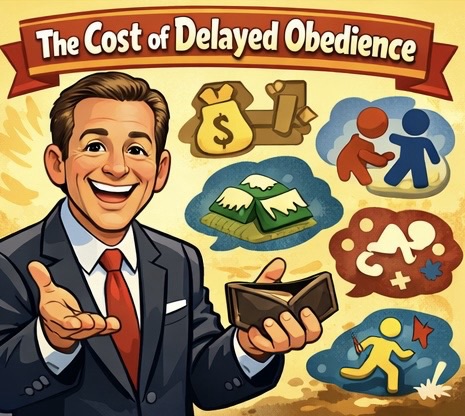
Delayed obedience can result in:
Missed divine opportunities
Loss of spiritual authority
Reduced impact and fruitfulness
Discipline instead of reward
God raising another vessel
“I made haste, and delayed not to keep thy commandments.” (Psalm 119:60, KJV)
Speed in obedience is a mark of spiritual maturity.
Jesus and Immediate Obedience

When Jesus called His disciples, Scripture repeatedly records one phrase:
“And straightway they followed him.” (Matthew 4:20, KJV)
Not after analysis.
Not after adjustment.
Immediately.
The Kingdom advances through people who obey God when He speaks, not when it becomes convenient.
Obedience Is a Trust Issue
At its core, delayed obedience questions God’s wisdom and timing. Prompt obedience declares, “God knows best—even when I don’t.”
“Trust in the LORD with all thine heart; and lean not unto thine own understanding.” (Proverbs 3:5, KJV)
Conclusion: Heaven Responds to Now
God’s instructions are rarely abstract. They are time-bound. What God says now is meant to be done now. Yesterday’s obedience does not cover today’s instruction.
If God has spoken—through His Word, through counsel, or by the Spirit—the safest place is immediate obedience.
Delayed obedience is not caution.
It is not wisdom.
It is disobedience.
And obedience—prompt, joyful, and complete—remains the doorway to God’s best.
The Message Bearer (SmilingPreacher), Cornelius Bella

 corneliusbella