Primary Text: Romans 1:24–27
This passage is one of the most theologically weighty and pastorally sensitive portions of Scripture. To understand it fully, we must let Scripture interpret Scripture.

When approached carefully, this text becomes clearer, deeper, and more redemptive than many surface-level readings suggest.
1. The Literary and Theological Context of Romans 1
Paul’s letter to the Romans is a carefully structured argument showing why the gospel is necessary for all humanity.
In Epistle to the Romans, chapter 1 lays the foundation:
– Humanity has knowledge of God (Romans 1:19–20)
– Humanity suppresses that knowledge (v.18) This suppression leads to idolatry (v.21–23)
– Idolatry produces moral and spiritual disorder (v.24 onward)
Romans 1:24–27 is therefore consequence-focused, not behavior-focused in isolation.
2. “God Gave Them Over” — A Concordance Study
Greek Term: paradidōmi
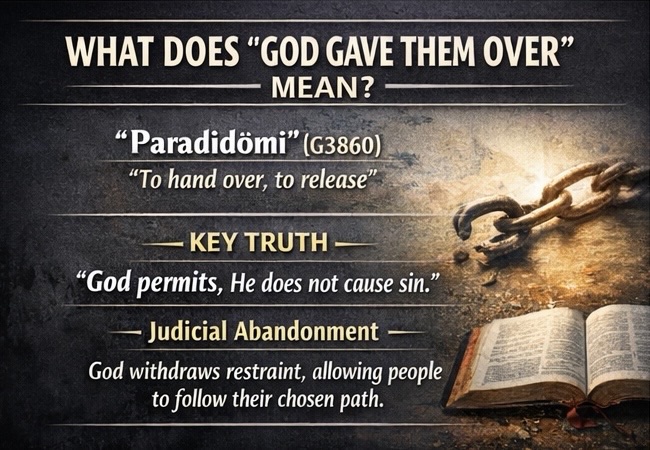
Using Strong’s Concordance (G3860), the phrase “God gave them over” means:
to hand over, deliver up, relinquish control
This word is used elsewhere:
Jesus being “delivered” to crucifixion (Matthew 26:15) God handing Jesus over according to His redemptive plan (Romans 8:32)
📌 Key Insight:
God “giving over” does not mean God actively causing sin. It means God removes restraint, allowing people to follow the direction they have persistently chosen.
This is a form of judicial abandonment, not emotional abandonment.
3. Romans 1:24 — Desire, Dishonour, and the Body
Amplified Bible (Classic Edition)
“Therefore God gave them up in the lusts of their own hearts to sexual impurity, to the dishonoring of their bodies among themselves.”
Bible Dictionary Insight
According to Vine’s Expository Dictionary, lust (epithymia) refers to:
a strong desire that dominates the will
Paul’s point is not merely sexual misconduct, but desire ruling instead of God.
📌 Theological Pattern:
Wrong worship → wrong desires → wrong actions The body becomes dishonoured after the heart abandons truth
4. Romans 1:25 — The Great Exchange
New Living Translation (NLT)
“They traded the truth about God for a lie. So they worshiped and served the things God created instead of the Creator himself.”
Bible Dictionary (Idolatry)
Idolatry is defined as:
attributing ultimate worth to anything other than God
This verse is the center of the passage. Everything that follows flows from this exchange.

📌 Critical Insight:
Moral confusion is always rooted in theological substitution.
Before behaviour changes, allegiance changes.
5. Romans 1:26 — “Dishonorable Passions”
English Standard Version (ESV)
“For this reason God gave them up to dishonorable passions.”
Greek Word: pathē atimias
From Strong’s Concordance:
pathē — overpowering emotions or impulses atimias — disgrace, loss of honour
📌 Paul is describing desires that dishonour God’s design, not merely acts that offend social norms.
6. Romans 1:26–27 — “Against Nature”
New American Standard Bible (NASB)
“For their women exchanged the natural function for that which is unnatural…”
Bible Dictionary on “Nature”
The term nature (physis) refers to:
God’s created order and intended design
Paul’s argument is creation-based, not culture-based. He appeals back to Genesis, where male and female complementarity is established (Genesis 1:27; 2:24).
📌 Important Clarification:
Paul is not isolating one sin as uniquely damning. In the same chapter, he lists:

Greed Envy Murder Deceit Disobedience to parents (Romans 1:29–31)
This passage is illustrative, not selective.
7. “Receiving in Themselves the Due Penalty” — What Does This Mean?
Holman Bible Dictionary
The “penalty” refers to:
the inherent consequences of rejecting God’s moral order
This is not arbitrary punishment. It is cause and effect.
📌 Sin carries consequences within itself.
8. Romans 1 as a Mirror, Not a Weapon
Paul’s goal is not condemnation but conviction.
He will soon say:
“Therefore you are without excuse, O man, whoever you are who judge…” (Romans 2:1)
Every reader is meant to see themselves as needing grace, not as standing above others.
9. The Gospel Beyond Romans 1
Romans 1 diagnoses the disease. Romans 3–8 reveal the cure.
Romans 3:23–24 (NKJV)
“For all have sinned and fall short of the glory of God, being justified freely by His grace through the redemption that is in Christ Jesus.”
Romans 8:1
“There is therefore now no condemnation to those who are in Christ Jesus.”
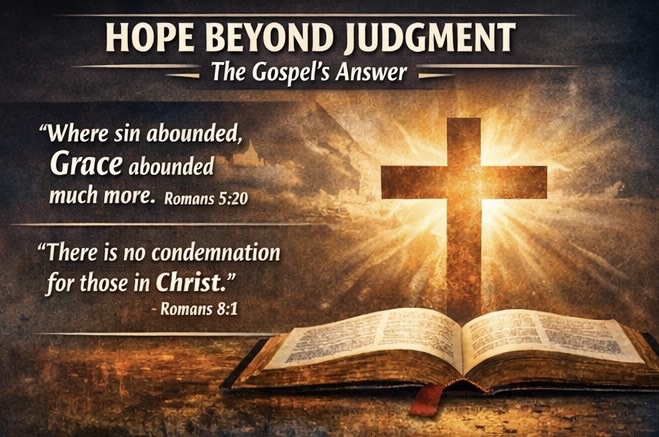
📌 The same God who “gave them over” in judgment gives Himself in redemption.
Summary
Romans 1:24–27 teaches us that:
– Sin begins with false worship
– Desire becomes disordered when truth is exchanged
– God’s judgment is often permission, not intervention
– No one is exempt from the need for grace
– The gospel offers restoration where sin brought ruin
This passage does not end with despair—it prepares us for the power of salvation.
The deeper the diagnosis, the greater the appreciation for grace.
Pastoral Application: Shepherding Hearts in Light of Romans 1:24–27
Sound doctrine must always lead to wise pastoral care. Romans 1:24–27 is not merely a theological exposition; it is a passage that calls for gentle shepherding, personal reflection, and redemptive ministry.
Below are pastoral applications designed to help believers, leaders, and churches apply this text with truth, humility, and grace.
1. For Personal Self-Examination (Before We Address Others)
Romans 1 invites us to look inward before outward.
Paul’s emphasis is not “them” but humanity apart from God.
Every believer should ask:
What am I tempted to exchange God for—comfort, approval, success, pleasure, identity?
Where have my desires begun to lead my convictions instead of Scripture shaping my desires?
📖 “Search me, O God, and know my heart…” (Psalm 139:23)
Pastoral Guidance:
Repentance begins not with behaviour modification but with restored worship.
When God is rightly enthroned, desires realign.
2. For Pastors and Church Leaders (Teaching Without Crushing)
Romans 1 must never be preached as a club but as a diagnosis.
Paul does not isolate one group as morally superior or inferior. In fact, Romans 2 removes any ground for spiritual pride.
Healthy Pastoral Posture:
– Teach the text clearly, without dilution
– Teach it humbly, remembering personal need for grace
– Teach it redemptively, always pointing forward to Christ
📌 Truth without grace wounds.
📌 Grace without truth misleads.
📌 Biblical ministry holds both together.
3. For Those Struggling with Sexual Sin or Conflicted Desires
Romans 1 does not say that struggle equals rejection by God. It speaks of unrestrained desire, not resisted temptation.
The Bible consistently distinguishes between:
Temptation (experienced by all) Identity (who we are in Christ)
Practice (what we choose to act upon)
📖 “Such were some of you. But you were washed…” (1 Corinthians 6:11)
Pastoral Assurance:
Struggle is not disqualification. Silence, isolation, and shame are far more dangerous than honest confession and discipleship.
The church must be a place where:
– Truth is upheld
– Grace is extended
– Transformation is expected over time
4. For Counseling and Discipleship (Addressing the Root, Not Just the Fruit)
Romans 1 shows us that behaviour flows from belief.
Pastoral care must therefore go deeper than surface correction:
– What is the person worshipping?
– Where has truth been exchanged for a lie?
– What pain, fear, or unmet need has shaped desire?
📌 You cannot disciple people out of sin without discipling them into truthful worship.
Effective discipleship restores:
– Right view of God
– Right view of self
– Right understanding of identity in Christ
5. For the Church’s Witness in a Confused Culture
The church must resist two extremes:
– Compromise, which empties the gospel of power – Hostility, which misrepresents the heart of Christ
Romans 1 calls the church to be:
– Clear without cruelty
– Convicted without contempt
– Faithful without fear
📖 “Speaking the truth in love…” (Ephesians 4:15)
Pastoral Wisdom:
We do not win people by affirming their brokenness, nor by attacking them for it—but by introducing them to the Healer.
6. For Hope and Restoration (The Bigger Gospel Story)
Romans 1 is not the final word—Romans 8 is.
Where sin reigns, grace overflows.
Where desire is disordered, the Spirit renews.
Where God once “gave them over,” He now calls them home.
📖 “There is therefore now no condemnation for those who are in Christ Jesus.” (Romans 8:1)
Pastoral Prayer
Father, keep our hearts from exchanging Your truth for lesser loves.
Restore right worship where desires have gone astray.
Give us grace to walk in holiness, humility, and compassion.
Make Your church a place of truth, healing, and transformation.
Through Jesus Christ our Lord. Amen.
Takeaway
Romans 1:24–27 does not call us to stand above sinners—it calls us to stand beneath the cross, where all of us are equally dependent on grace.
The gospel confronts sin honestly and heals sinners completely.
Q&A Clarification Appendix
Addressing Sensitive and Common Questions from Romans 1:24–27
This appendix is designed to help pastors, teachers, leaders, and readers respond wisely to honest questions that often arise from Romans 1:24–27. The aim is clarity without compromise, truth without hostility, and grace without confusion.
Q1. Is Romans 1:24–27 saying God causes people to sin?
No.
Romans 1 teaches that God permits, not produces, sin.
The repeated phrase “God gave them over” describes judicial permission—God allowing people to pursue what they have already chosen after persistently rejecting truth.
Key distinction:
God is not the author of sin God is the righteous Judge who may remove restraint
📖 “God cannot be tempted by evil, nor does He tempt anyone.” (James 1:13)
Q2. Does this passage mean God stops loving people who sin this way?
Absolutely not.
Romans 1 describes judgment, not the end of God’s love. The same letter later declares:
God demonstrates His love while we were still sinners (Romans 5:8)
Nothing can separate believers from God’s love (Romans 8:38–39)
God’s love is constant—even when His restraint is withdrawn.
📌 Important pastoral truth:
Divine displeasure is not the same as divine abandonment.
Q3. Is this passage singling out homosexuality as the worst sin?
No.
Romans 1 uses same-sex misbehaviour as an example, not an exclusive category.
In the same chapter, Paul lists many sins often overlooked:
Greed Envy Strife Gossip Arrogance Disobedience to parents (Romans 1:29–31)
And in Romans 2, Paul turns to the moral and religious reader and says:
“You are without excuse.”
📌 Conclusion:
Romans 1 levels the ground—it does not rank sinners.
Q4. What does “against nature” really mean?
“Nature” refers to God’s created order, not personal feelings or cultural trends.
Paul’s argument is rooted in creation theology (Genesis 1–2), where male and female complementarity is presented as God’s design.
📌 This is not about:
What feels natural or What society normalizes
It is about:
God’s original intent as Creator
Q5. What about people who say, “This is how I was born”?
Scripture acknowledges that fallen humanity inherits disordered desires of many kinds—not only sexual ones.
The Bible never defines identity by desire but by relationship to Christ.
📖 “If anyone is in Christ, he is a new creation.” (2 Corinthians 5:17)
📌 Pastoral clarity:
Having a desire does not equal moral approval, nor does it remove the possibility of transformation.
Q6. Is temptation the same as sin?
No.
The Bible distinguishes between:
– Temptation — being drawn toward something
– Sin — yielding to it
Jesus Himself was tempted, yet without sin (Hebrews 4:15).
📌 Struggle is not sin.
📌 Desire resisted is not rebellion.
📌 The Christian life is one of ongoing transformation, not instant perfection.
Q7. Does Romans 1 leave room for repentance and change?
Yes—abundantly.
Romans 1 is written to lead us to:
Romans 3 — justification by grace
Romans 6 — freedom from sin’s dominion
Romans 8 — life in the Spirit
📖 “Such were some of you. But you were washed…” (1 Corinthians 6:11)
📌 The Bible never presents sin as stronger than grace.
Q8. How should Christians speak about this passage publicly?
With truth, humility, and compassion.
We must avoid:
– Mockery
– Hostility
– Self-righteousness
And embody:
– Conviction rooted in Scripture
– Compassion shaped by Christ
– Courage without cruelty
📖 “The servant of the Lord must not strive, but be gentle unto all.” (2 Timothy 2:24)
Q9. How should the church care for people wrestling with these issues?
By being:
– Biblically faithful — not redefining sin
– Pastorally present — not abandoning people
– Spirit-led — trusting God’s transforming power
True care does not affirm what Scripture forbids, but neither does it reject those Christ invites.
📌 The church is a hospital for sinners, not a museum for saints.
Q10. What is the ultimate message of Romans 1:24–27?
Not condemnation—but warning with hope.
It reveals:
– The danger of rejecting truth
– The seriousness of idolatry
– The need for the gospel
Romans 1 prepares the way for Romans 8.
Where sin exposes humanity’s need, grace reveals God’s answer.
Closing Pastoral Reminder
Romans 1 confronts us all with the same question:
Will we worship the Creator—or something else?
The good news is this:
No matter how far one has gone, the door of repentance remains open, and the grace of God in Christ is sufficient.
A Call to Salvation: Responding to God’s Grace
Romans 1 shows us the seriousness of turning away from God—but it does not leave us without hope. The same God who reveals truth also extends mercy through Jesus Christ.
No matter how far someone feels they have gone, God’s grace reaches farther.
The Bible says:
“But now the righteousness of God apart from the law is revealed… through faith in Jesus Christ, to all and on all who believe.”
— Romans 3:21–22
Salvation is not about fixing yourself first. It is about coming to God as you are and receiving the life He freely gives through His Son.
If you want to give your life to Jesus today, pray this prayer sincerely:
Salvation Prayer
Father God,
I come to You just as I am.
I acknowledge that I have sinned and fallen short of Your glory.
I believe that Jesus Christ died for my sins and rose again on the third day.
Today, I turn away from sin and receive Your grace.
Lord Jesus, I confess You as my Lord and Savior.
Come into my heart, forgive me, and make me new.
I receive eternal life, and I choose to follow You from this day forward.
In Jesus’ Name, Amen.
If you prayed this prayer sincerely, welcome to the family of God. Heaven rejoices over your decision, and a new chapter has begun in your life.
You Were Not Saved to Walk Alone — Join Us at Church
Salvation is the beginning, not the end. God designed us to grow, heal, and thrive in community.
We warmly invite you to connect with Dream Centre of the Life Oasis International Church, a Bible-believing, Spirit-led church family committed to teaching God’s Word with clarity, power, and love.
How to Connect with Dream Centre
Church: The Dream Centre of the Life Oasis International Church
Website: http://www.dreamcentreoftheloic.org
Email: info@dreamcentre.org
Phone: +2348037252124
Join Our Live Services & Broadcasts:
YouTube: youtube.com/DreamCentreLiveSTREAMING/live
DCIRadio: dciradio.org
Facebook: facebook.com/ReverendAreogun
Mixlr: mixlr.com/reverendareogun
Radio Garden: radio.garden/listen/dream-centre-internet-radio/ZxXuhLKS
Telegram Updates: t.me/DCNewLiveUpdates?livestream
At Dream Centre, you will:
– Learn God’s Word systematically
– Grow in faith and spiritual maturity
– Be cared for and discipled
– Discover God’s purpose for your life
Final Encouragement
No matter your past, God’s grace is greater.
No matter your struggle, God’s power is sufficient.
And no matter where you are now, God is calling you forward.
You are loved. You are welcome. And your journey with God has just begun. 🙏
Message Bearer (SmilingPreacher), Cornelius Bella

 corneliusbella