Write about your first name: its meaning, significance, etymology, etc.
One of the simplest questions we are asked in life is, “What is your name?” Yet few questions are more profound. A name is often the very first gift we receive in life—before achievements, before identity, before even consciousness.

In Scripture, names are never casual. They carry meaning, destiny, authority, and sometimes even prophecy.
“A good name is better than riches.” – Ecclesiastes 7:1
This reflection invites me to look inward and upward at my own first name: Cornelius.
The Meaning and Etymology of Cornelius
The name Cornelius is of Latin origin, derived from the Roman family name Cornelii, one of the most distinguished and noble lineages in ancient Rome.
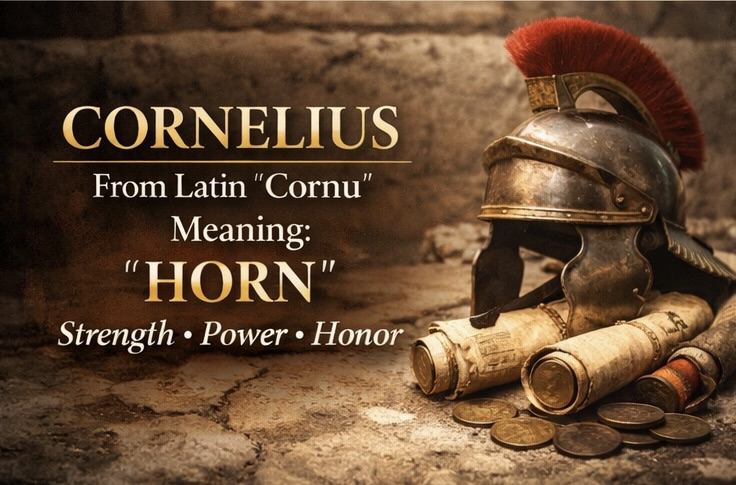
At its root, Cornelius is connected to the Latin word cornu, meaning:
Horn – a symbol of strength, power, and honour Authority and prominence Fruitfulness and visibility
In biblical symbolism, the horn represents:
Power (1 Samuel 2:10)
Exaltation (Psalm 89:17)
Divine strength (Habakkuk 3:4)
So at its most basic level, the name Cornelius points to strength with purpose, not for ego, but for service.
Cornelius in the Bible: A Name with Spiritual Weight
The most famous Cornelius in Scripture appears in Acts 10.
“There was a certain man in Caesarea called Cornelius, a centurion… a devout man, one that feared God with all his house.” – Acts 10:1–2
This Cornelius was:
A military leader (centurion)
A man of prayer
A giver (generous to the poor)
A seeker of truth
The first recorded Gentile convert into the New Testament Church

His story is not just historical—it is revolutionary.
Through Cornelius, God:
Opened the Gospel to the nations
Broke religious barriers
Redefined inclusion in Christ
Cornelius became a gateway name—associated with access, transition, and divine expansion.
The Spiritual Significance of Bearing This Name
To bear the name Cornelius is to carry a quiet reminder of:
1. Calling Beyond Boundaries
Cornelius represents people positioned at the intersection of cultures, systems, and destinies. He was Roman by profession, yet spiritual by pursuit. God used him to connect worlds.
2. Leadership with Devotion
He had rank, but also reverence. Authority, but also humility. He reminds us that spiritual influence is more powerful than positional influence.
3. Prayer That Opens Heaven
Cornelius’ prayers did not go unnoticed.
“Your prayers and alms have come up for a memorial before God.” – Acts 10:4
His life teaches that:
Prayer can trigger divine encounters
Generosity can attract divine attention
Obedience can rewrite history
Identity, Destiny, and Divine Intention
In the Bible, God often changed names when He changed destinies:
Abram → Abraham Jacob → Israel Simon → Peter
This tells us something important:
Names are not merely for identification—they are for revelation.
While I did not choose my name, I believe God allowed it. And over time, I have seen how its meaning aligns with calling:
Strength for service
Leadership for others
Influence for impact
Prayer for breakthrough

My name reminds me that I am not called just to exist—but to stand, serve, and open doors for others, just as the biblical Cornelius did.
What Your Name Is Saying to You
Your name—whatever it is—carries:
Cultural history
Family heritage
Spiritual potential
It may not define you fully, but it can point you toward who God designed you to become.
The real question is not:
What does your name mean?
But rather:
What is God making of you through it?
Final Reflection
A name is not a prison—it is a seed.
And like every seed, its full meaning is revealed in growth, obedience, and purpose.

For me, Cornelius is not just a word.
It is a reminder that:
God places people strategically—across cultures, systems, and generations—so that His purpose can move forward through willing vessels.
And perhaps that is the deepest truth of all:
Our names may come from our parents, but our purpose comes from God.
The Message Bearer (SmilingPreacher), Cornelius Bella

 corneliusbella