“Blessed are the peacemakers: for they shall be called the children of God.” — Matthew 5:9 (KJV)
The world is full of unrest. Families are splitting apart, nations are at war, and even in the Body of Christ, offences and misunderstandings break fellowship. In the midst of this chaos, God has a special category of people He calls peacemakers.
Peacemakers are not passive bystanders. They are active bridge-builders — reconciling men to God, and men to each other. They step into troubled waters, guided by the Holy Spirit, and bring the calm of Christ where storms rage.
The Twofold Work of a Peacemaker
A peacemaker’s work is essentially to bring harmony where there’s conflict, understanding where there’s misunderstanding, and reconciliation where there’s division — whether in families, communities, nations, or even within the church.
From a biblical perspective, the role of a peacemaker is both spiritual and practical:
1. Reconciling People to God
• Core Work: Helping people turn from sin and be restored to a right relationship with God through the Gospel.
• Scripture:
“Therefore, we are ambassadors for Christ, God making his appeal through us. We implore you on behalf of Christ, be reconciled to God.” — 2 Corinthians 5:20 (ESV)
• This is the highest form of peace — peace with God.
2. Reconciling People to People
• Core Work: Helping individuals or groups resolve disputes, forgive, and rebuild trust.
• Scripture:
“Blessed are the peacemakers: for they shall be called the children of God.” — Matthew 5:9 (KJV)
• A peacemaker doesn’t just avoid conflict; they engage to transform it into understanding.
3. Promoting Justice and Fairness
• Core Work: Addressing root causes of unrest — injustice, oppression, and inequality — so that peace is not just the absence of fighting, but the presence of righteousness.
• Scripture:
“The work of righteousness shall be peace; and the effect of righteousness quietness and assurance for ever.” — Isaiah 32:17 (KJV)
4. Cultivating Peace in Attitudes and Environments
• Core Work: Speaking and acting in ways that calm tension, encourage listening, and foster mutual respect.
• Scripture:
“Let us therefore make every effort to do what leads to peace and to mutual edification.” — Romans 14:19 (NIV)
5. Modeling Christ’s Example of Peace
• Core Work: Living in such a way that one’s life becomes a testimony of gentleness, patience, humility, and love.
• Scripture:
“For He Himself is our peace, who has made the two groups one and has destroyed the barrier, the dividing wall of hostility.” — Ephesians 2:14 (NIV)
✅ In summary:
A peacemaker is a bridge-builder — between God and man, and between people. They don’t just stop quarrels; they plant the seeds of lasting reconciliation by dealing with the root issues, guided by truth and love.
Step-by-Step Biblical Profile of a Peacemaker
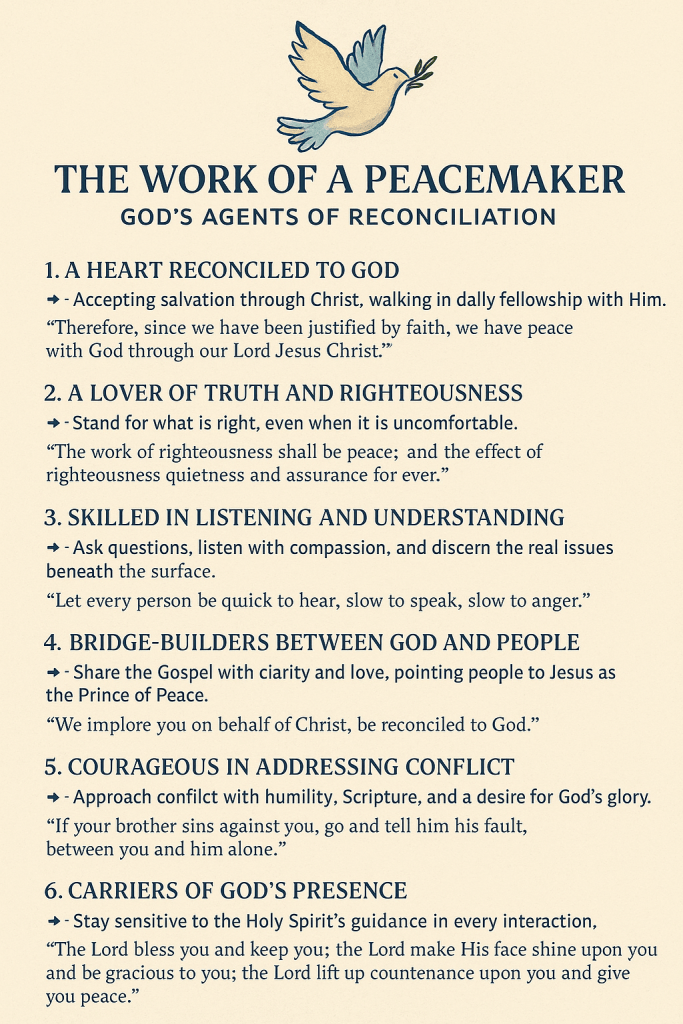
1. A Heart Reconciled to God
• Quality: A peacemaker must first have peace with God before they can bring peace to others.
• Method: Accepting salvation through Christ, walking in daily fellowship with Him.
• Scripture:
“Therefore, since we have been justified by faith, we have peace with God through our Lord Jesus Christ.” — Romans 5:1 (ESV)
• Result: Their ministry flows from a heart anchored in God’s peace.
2. A Lover of Truth and Righteousness
• Quality: True peace is built on righteousness, not compromise with sin.
• Method: Stand for what is right, even when it is uncomfortable.
• Scripture:
“The work of righteousness shall be peace; and the effect of righteousness quietness and assurance for ever.” — Isaiah 32:17 (KJV)
• Result: They bring lasting peace, not temporary silence.
3. Skilled in Listening and Understanding
• Quality: Peacemakers don’t rush to speak; they seek to understand.
• Method: Ask questions, listen with compassion, and discern the real issues beneath the surface.
• Scripture:
“Let every person be quick to hear, slow to speak, slow to anger.” — James 1:19 (ESV)
• Result: People feel heard, trust is built, and hearts open for reconciliation.
4. Bridge-Builders Between God and People
• Quality: They carry the message of reconciliation as ambassadors of Christ.
• Method: Share the Gospel with clarity and love, pointing people to Jesus as the Prince of Peace.
• Scripture:
“We implore you on behalf of Christ, be reconciled to God.” — 2 Corinthians 5:20 (ESV)
• Result: Souls restored to God, the deepest form of peace achieved.
5. Courageous in Addressing Conflict
• Quality: Peacemakers do not avoid tough conversations; they enter them prayerfully.
• Method: Approach conflict with humility, Scripture, and a desire for God’s glory.
• Scripture:
“If your brother sins against you, go and tell him his fault, between you and him alone.” — Matthew 18:15 (ESV)
• Result: Issues are addressed before they escalate, relationships are preserved.
6. Carriers of God’s Presence
• Quality: They cultivate a life of prayer and worship, allowing God’s peace to flow through them.
• Method: Stay sensitive to the Holy Spirit’s guidance in every interaction.
• Scripture:
“The Lord bless you and keep you; the Lord make His face shine upon you and be gracious to you; the Lord lift up His countenance upon you and give you peace.” — Numbers 6:24–26 (ESV)
• Result: Their very presence becomes a calming influence in tense situations.
7. Builders of Community Harmony
• Quality: They promote unity and mutual edification in the Body of Christ.
• Method: Encourage cooperation, pray for one another, and avoid gossip.
• Scripture:
“Let us therefore make every effort to do what leads to peace and to mutual edification.” — Romans 14:19 (NIV)
• Result: Churches and families become safe havens of love and trust.
The Eternal Reward of Peacemakers
Jesus did not say blessed are those who love peace, but blessed are the peacemakers. Why? Because peacemakers reflect the very nature of God — our ultimate Peacemaker through Christ.
Their reward? They shall be called the children of God (Matthew 5:9). This isn’t just a title; it’s divine recognition that they are walking in their Father’s footsteps.
Final Call
If you are in Christ, you are called to be a peacemaker. Start in your home, in your church, in your workplace. Seek peace, speak peace, and sow peace. Remember, peace is not the absence of conflict — it is the presence of Christ.
“And the peace of God, which surpasses all understanding, will guard your hearts and your minds in Christ Jesus.” — Philippians 4:7 (ESV)
The Message Bearer, Cornelius Bella

 corneliusbella