Muslim scholars often say:
“Show us where Jesus said, ‘I am God, worship Me.’”
While Jesus may not have used these exact English words, He made multiple clear and deliberate statements that declare His divinity, and the Jews of His time erroneously understood those statements as blasphemy to their detriment.
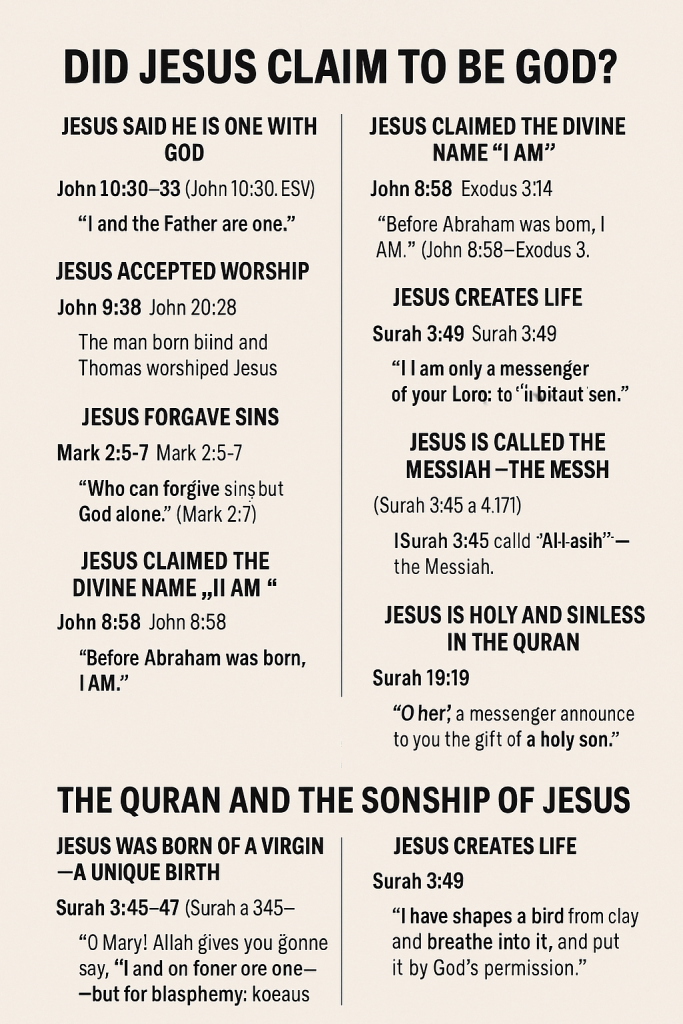
1. Jesus Said He Is One with God (John 10:30–33)
“I and the Father are one.” (John 10:30, ESV)
Response:
The Jews understood this as a claim to deity:
“We are not stoning you for any good work,” they replied, “but for blasphemy, because you, a mere man, claim to be God.” (John 10:33, NIV)
2. Jesus Accepted Worship
Unlike angels and prophets who reject worship (Revelation 22:8–9, Acts 10:25–26), Jesus receives worship repeatedly:
• The man born blind worshipped Him (John 9:38)
“Then the man said, ‘Lord, I believe,’ and he worshiped Him.”
• Thomas calls Him “My Lord and My God” (John 20:28)
Jesus did not rebuke him but affirmed it.
3. Jesus Forgave Sins (Mark 2:5–7)
“Son, your sins are forgiven.”
The Pharisees rightly said:
“Who can forgive sins but God alone?” (Mark 2:7)
Jesus responded by performing a miracle to prove His authority to forgive sins—which only God can do.
4. Jesus Claimed the Divine Name “I AM” (Exodus 3:14 & John 8:58)
“Before Abraham was born, I AM.” (John 8:58, KJV)
The Jews immediately tried to stone Him because He used God’s covenant name (YHWH) for Himself.
5. Jesus Has Divine Titles and Attributes
• “The First and the Last” — a title used by God (Isaiah 44:6; Revelation 1:17–18)
• “The Alpha and the Omega” — title for God and also Jesus (Revelation 1:8, 22:13, 22:16)
The Qur’an and the Sonship of Jesus
While the Qur’an explicitly denies that Jesus is the Son of God in some verses (e.g., Surah 112:3, “He begets not, nor is He begotten”), there are other Qur’anic references that, when examined deeply and spiritually, unintentionally affirm truths that align with Christian belief.
1. Jesus Was Born of a Virgin — a Unique Birth (Surah 3:45–47)
“‘O Mary! Allah gives you good news of a Word from Him, his name will be the Messiah, Jesus, son of Mary—honored in this world and the Hereafter, and one of those nearest to God.’” (Qur’an 3:45)
Response:
• Only Jesus is called “a Word from God” (Kalimatullah) in the Qur’an.
• Born without a human father — by divine command.
• The only other person created directly by God is Adam, but Jesus is called “a Word from God” and “a Spirit from Him” (Surah 4:171) — terms never used for any other prophet.
2. Jesus is Called the Messiah (Al-Masih)
Qur’an 3:45 and 4:171 both call Him “Al-Masih” — the Messiah.
Response:
The Qur’an gives Jesus titles no other prophet received, and the Bible clearly teaches that the Messiah is divine:
“The virgin will conceive and give birth to a son, and will call him Immanuel” (Isaiah 7:14)
“Immanuel means God with us” (Matthew 1:23)
3. Jesus is Holy and Sinless in the Qur’an
“[The angel said]: I am only a messenger of your Lord to announce to you the gift of a holy son.” (Surah 19:19)
Response:
Only Jesus is described as “holy” — even Muhammad is told to ask forgiveness (Surah 40:55, 47:19).
This aligns with Hebrews 4:15:
“He was tempted in every way, yet without sin.”
4. Jesus Creates Life
“I have come to you with a sign from your Lord: I make for you out of clay the figure of a bird, then I breathe into it, and it becomes a bird by God’s permission.” (Surah 3:49)
Response:
Jesus does what only God does — breathe life.
Compare with Genesis 2:7:
“God breathed into man’s nostrils the breath of life.”
This mirrors the creative power of God.

CONCLUSION
Even though the Qur’an denies the Sonship of Christ, it inadvertently affirms His divine uniqueness. Combined with clear Biblical evidence, we can confidently declare:
Jesus is God in the flesh. He said so, proved it through His actions, and received worship as God.
“In Him dwells all the fullness of the Godhead bodily.” (Colossians 2:9)
The Message Bearer, Cornelius Bella

 corneliusbella